

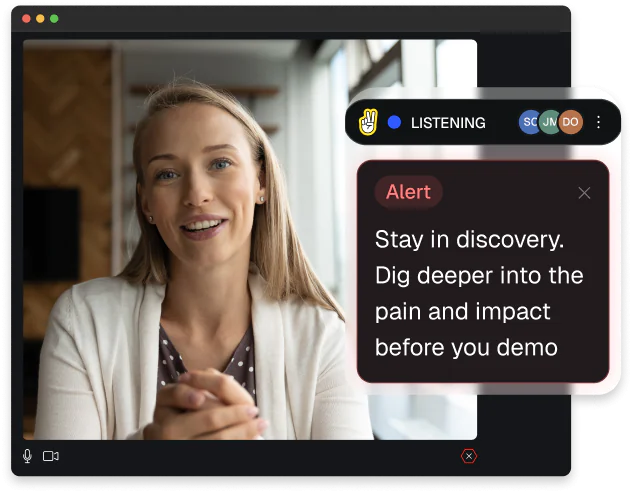
Most onboarding checklists end the day the rep “completes” them. Then ramp drags for months anyway. A good sales rep onboarding checklist connects tasks to live-call behavior. This guide gives enterprise sales leaders and enablement teams a usable checklist first, then shows how to make the plan stick.
Key takeaways
- A sales rep onboarding checklist should connect tasks to verified call behaviors rather than only course completion or system access.
- A sales rep onboarding plan works better when milestones follow week one, weeks two to four, and 90-day targets.
- Effective sales rep onboarding methods combine role-play, call shadowing, manager feedback, and live guidance during early customer conversations.
- Sales leaders identify struggling new reps by reviewing skipped discovery steps, weak qualification, blank CRM fields, and delayed follow-ups.
- Call summaries and recordings improve coaching because managers can point to exact moments instead of general feedback.
- Performance data helps onboarding teams refine milestones, remove low-value tasks, and focus training on behaviors tied to ramp.
The Sales Rep Onboarding Checklist
Start here. This sales rep onboarding checklist breaks the first 90 days into four phases, so a new hire moves from systems access to closing without guessing what matters next. Use it as a sales rep onboarding plan template and adapt the timeline to your deal cycle.
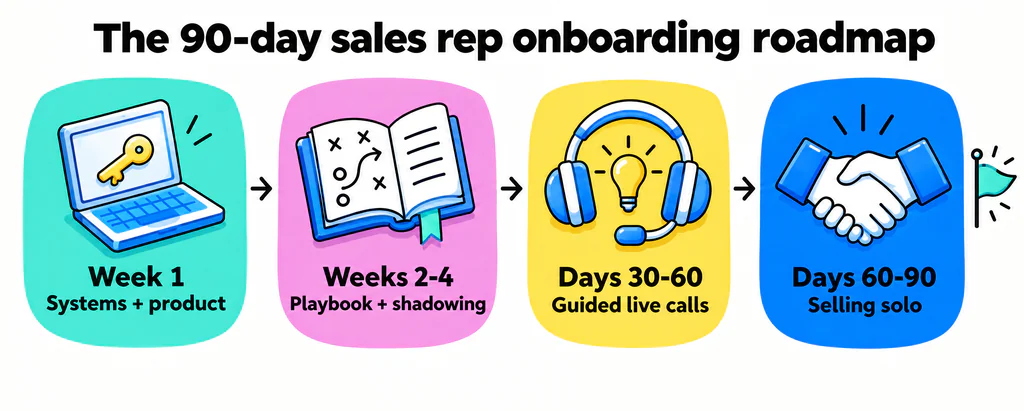
Week 1: systems, product, ICP, tools access
Week one is setup, not selling. Get the basics done so the rep is not blocked later.
- Provision CRM, email, dialer, and meeting tools with the right permissions.
- Walk the product, the ICP, and the top three buyer personas.
- Assign a peer buddy and book the first manager one-on-one.
- Confirm access to the playbook, company knowledge, battle cards, and call library.
Weeks 2-4: playbook, methodology, messaging, shadowing
Now the rep learns how you sell. Tie every module to a real call they will run soon.
- Teach the playbook, qualification framework, and core messaging.
- Run methodology training (MEDDICC or SPICED) with worked deal examples.
- Shadow three to five live calls from tenured reps.
- Practice discovery and objection handling in role-play, then get feedback.
Days 30-60: first live calls with guidance, certification, role-play
The rep starts running calls with support. The goal is clear: reps execute the playbook live, while good habits are still forming.
- Run first live discovery calls with a manager or real-time guidance.
- Certify on the pitch, demo, and objection handling.
- Review every early call and fix one thing before the next.
- Build a starter pipeline with guided prospecting.
Days 60-90: independent calls, pipeline build, first deals
By now the rep should run the motion solo. Watch for consistency, not one good week.
- Run full-cycle calls independently.
- Hit activity and pipeline targets without prompting.
- Close first deals and debrief the wins and losses.
- Confirm the rep runs the methodology the same way every time.
How to Build a Sales Rep Onboarding Plan That Sticks
A checklist tells reps what to do. A sales rep onboarding plan tells them how to get good and how you will know they did. The plan starts working when managers measure behavior, not attendance.
Tie milestones to behaviors beyond task completion
Checking a box does not prove a skill. A rep can finish every module and still freeze on discovery. So tie each milestone to a behavior a manager can verify on a real call, like a clean qualification or a handled objection. That way, “done” means the rep can perform it when a buyer is in the meeting.
30-60-90 framework
The checklist above already lays out what a rep does in each phase. The plan adds the other half: the gate they must clear and the warning sign that says they are stuck. Read the table by column, not by row, so a manager knows what to certify and what to watch for before the number ever moves.
| Window | Gate the rep must clear | Sign the rep is stuck |
| Day 30 | Certifies on ICP, product, and a guided discovery | Cannot recall the ICP or skips steps in a walked-through call |
| Day 60 | Runs live calls with support and live battle cards | Freezes without prompts; can’t answer basic customer questions |
| Day 90 | Runs the methodology solo on real deals | Inconsistent week to week; reverts to old habits unwatched |
Make the playbook usable on live calls (not a PDF nobody opens)
A new rep is already carrying the heaviest cognitive load of their tenure, learning the product and the motion at the same time, and selling competes with constant admin. A static playbook asks the new hire to memorize the path first and recall it under pressure later. The onboarding fix is to surface the next discovery step inside the call, so following the playbook is the default behavior while the habit is still forming, not a document the rep has to remember to open.
Effective Sales Rep Onboarding Methods for Enterprise Teams
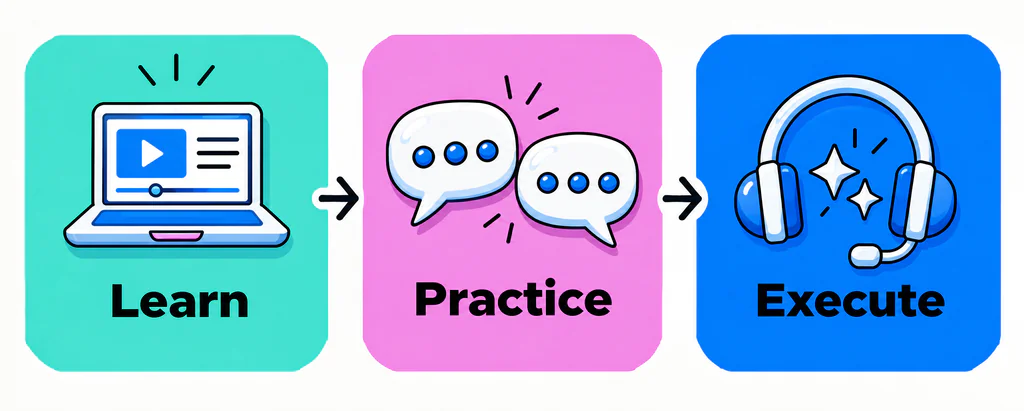
No single method ramps a rep. Effective sales rep onboarding methods combine learning, practice, and live execution so new knowledge has somewhere to go after onboarding week.
Blended learning (modules + role-play + live shadowing)
Reps do not build call judgment from lectures alone. Blend self-paced modules, live role-play, and call shadowing so the rep sees, practices, and applies the same skill. Each format gives the manager a different way to spot gaps.
Real-time guidance on early calls
The fastest way to build a skill is to use it correctly on the first live attempt. A real-time sales assistant reinforces your methodology during the call. It surfaces relevant questions, company knowledge, and objection guidance exactly when new reps need them.
Methodology embedding (MEDDICC/SPICED) from day one
A methodology only works when it shows up in live conversations. Embed MEDDICC or SPICED from day one and reinforce it on real calls instead of leaving it in training decks. The sales methodology toolkit helps teams turn a framework into repeatable call behavior.
Consistency across regions/teams (enterprise angle)
Enterprise onboarding has to produce the same operating standard across regions. Standardize the playbook, the certification bar, and the call structure so a buyer gets the same experience whether the rep sits in Austin or London. Consistency makes the program scalable instead of tribal.
How Sales Leaders Can Identify Where New Reps Are Struggling
The first close is a lagging signal. By the time a rep misses quota, you have lost a quarter. Leaders who catch struggles early read call data instead of pipeline alone.
Leading indicators in call data (skipped discovery, weak qualification)
Skipped discovery questions and blank qualification fields show up weeks before the number does. These leading indicators tell you which skill is missing while there is still time to coach it. A rep with meetings and no closes has a different problem than a rep with no meetings at all.
Where to intervene before bad habits set
The window to fix a habit is the first 90 days. Intervene when you see a rep skip the same step across several calls, while the behavior is still easy to change. Wait a quarter and you are retraining, not onboarding.
Manager visibility without sitting in every call
During onboarding a manager wants to sit in on every call and cannot. Structured call data gives sales leader workflows a record of what the new rep actually did, while custom insights, instant signals, and Ask WINN.AI Anything help surface the conversations that need attention.
Managers can quickly identify recurring objections, technical knowledge gaps, skipped methodology steps, unanswered questions, or competitor mentions without manually reviewing every conversation. The next one-on-one targets the real gap instead of a guess. That is the difference between coaching the rep you remember and coaching the calls they actually ran.
Using Call Summaries and AI Insights to Accelerate Rep Development
Call summaries and AI insights are coaching assets. They turn vague feedback into specific moments managers can review, understand, and coach against.
Coaching to specific moments, not vague feedback
“Be more consultative” helps no one. AI insights and call summaries highlight exactly where discovery went thin, qualification was skipped, or an objection wasn’t handled effectively. Specific feedback tied to real customer conversations changes the next call, so development compounds week over week.
Building a call library of “good” examples
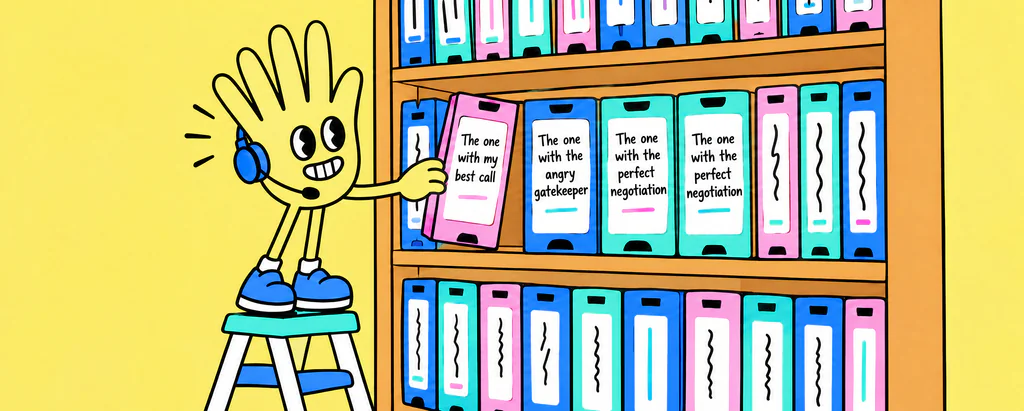
New reps learn from real wins, not hypotheticals. Build a library of strong discovery calls, demos, and objection saves, so a rep can study how your best closers run the motion. The library becomes onboarding content that reflects the current sales floor.
Auto summaries and AI insights that show what happened
Manual notes are incomplete and late. Auto-generated summaries and AI insights capture what happened during the conversation and surface recurring coaching opportunities, from missed discovery questions to technical knowledge gaps and objection handling. Managers can spend the one-on-one reinforcing the right behaviours instead of reconstructing the conversation.
Refining Your Onboarding Program Based on Real Performance Data
Onboarding should change when the evidence changes. Strong programs treat the checklist as a working document and tune it against what predicts ramp.
Which milestones predict quota attainment
Not every milestone matters equally. Look back at ramped reps and find which early behaviors, like discovery quality or pipeline built by day 60, correlate with hitting quota. Then weight the program toward those outcomes, not raw activity.
Closing gaps between training and field behavior
The gap between “trained” and “does it on calls” is where most programs leak. Compare what you teach to what reps do live, then close the difference. If a skill never shows up on calls, the training may need fixing before the rep does.
Iterating the checklist with evidence
Refresh the checklist with evidence, not opinion. Each cohort gives you data on what worked, so your sales rep onboarding checklist should get sharper over time. Drop the steps that do not move ramps and keep the ones that do.
How WINN.AI Guides New Reps Live on Every Call Until They’re Fully Ramped
An onboarding checklist can get your rep ready for the first call. It cannot sit beside them when the buyer asks a pricing question, skips ahead to procurement, or challenges the value prop.
That is where WINN.AI extends onboarding into the field. It gives your new reps personalized guidance during real customer conversations, then gives managers the evidence they need to know whether each rep is actually ramping.
Live guidance so a new rep runs a clean discovery on call one
WINN surfaces relevant discovery prompts, company knowledge, and in-the-moment guidance during the call. Guidance is personalized to help each rep improve their weakest areas rather than giving every rep the same coaching. It is also informed by what success looks like for your own team, reinforcing the behaviours and winning plays behind successful deals. A new rep can follow your discovery process without memorizing the full playbook first.
That changes what “onboarding complete” means. The rep is not just certified on your playbook. They are being guided through it while habits are still forming.
Live Answers from company knowledge (no stalling on product questions)
When a buyer asks something hard, your rep does not have to stall with “let me get back to you.” WINN pulls Live Answers from company knowledge mid-call, so a new hire has a better chance of giving the right answer in the moment.
Auto CRM updates + summaries managers coach from
WINN captures the conversation, updates the CRM, and generates summaries and follow-ups automatically. Your reps spend less time on admin, and managers get structured insights into rep execution they can coach from instead of relying on secondhand recaps.
Proof: playbook adoption gains and Deel MEDDICC results
WINN sources these results rather than promising them for every team. Its pages cite a lift in playbook adoption within the first weeks, and Deel reported a lift in MEDDICC adoption and win rates after embedding the methodology into WINN.
Results depend on CRM setup, playbook quality, and adoption. For onboarding teams, the useful idea is simple: keep the checklist, but make sure the rep has support when the checklist becomes a real buyer conversation. To see how that would work in your sales workflow, request a demo.
Frequently asked questions
Related

Best Sales Training Software that Builds Top Performers
Your reps finish onboarding, ace the quiz, then revert to old habits on the first live call. That gap is the whole problem. The best sales training software closes that gap by reinforcing the right behaviors during live customer conversations, not just in training modules. This guide compares the main categories of sales training platform, […]

How to Reduce Sales Rep Ramp Time with the Right Tools
Key takeaways Why New Rep Ramp Time Is Taking Too Long Reps usually ramp slowly because onboarding has to hold up during live buyer conversations. A plan can look clear in training and still break down when a new rep handles discovery, objections, and next steps in a live conversation. Once reps start selling, improvement […]

Top AI Sales Coaching Software to Boost Performance in 2026
Key takeaways What Is AI Sales Coaching Software AI sales coaching software analyzes sales conversations, scores them against a rubric, and gives reps and managers feedback they can act on. Instead of a manager listening to a handful of recordings, the software reviews every call and flags coaching moments at scale. Definition and core jobs […]