

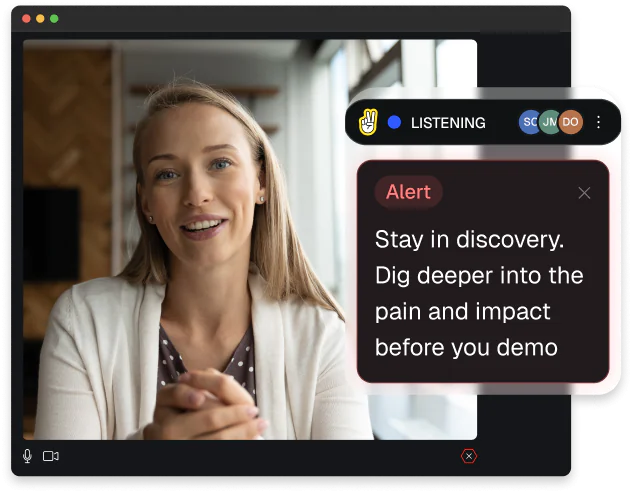
A manager can review maybe one call per rep per week. The rest happen without direct coaching. AI sales coaching software helps by identifying coaching opportunities, reinforcing selling behaviors, and showing where reps need support. Some tools also coach reps while the call is happening, not only after a manager reviews a recording. This guide is for sales leaders, RevOps, and enablement teams choosing a platform. It compares the main categories of AI sales coaching tools in a table, then shows where each one fits.
Key takeaways
- AI sales coaching software analyzes sales calls and identifies coaching moments that managers may miss during manual review.
- Real-time sales coaching reinforces your methodology, surfaces relevant guidance, and supports reps during live customer conversations, while post-call tools review recordings after meetings end.
- Sales leaders should compare AI sales coaching platforms by live guidance, scorecards, CRM sync, security, and manager workload.
- Gong and Chorus focus on post-call conversation analysis, while Second Nature and Hyperbound focus on role-play practice.
- Live coaching is the best fit when reps need support during the buyer conversation, not only after it.
- Teams should verify pricing, CRM integrations, security requirements, and meeting-bot behavior before choosing sales coaching software.
What Is AI Sales Coaching Software
AI sales coaching software analyzes sales conversations, scores them against a rubric, and gives reps and managers feedback they can act on. Instead of a manager listening to a handful of recordings, the software reviews every call and flags coaching moments at scale.
Definition and core jobs
The core jobs are analyzing conversations, identifying coaching opportunities, reinforcing your methodology, delivering real-time guidance where available, and giving managers structured coaching workflows. Good AI sales coaching tools tie each score back to a behavior a rep can change, so coaching points to the next discovery question rather than a vague “be more consultative.”
Real-time vs. post-call coaching
Post-call coaching reviews the recording after the meeting ends. Real-time coaching prompts the rep during the live call, when there is still time to ask the missed question. Both have a place, and the deeper mechanics of live feedback are covered in our real-time sales assistant explainer. In practice, retrospective tools explain what happened; live tools can affect the current conversation.

AI coaching software vs. conversation intelligence vs. enablement
These categories overlap but solve different jobs. Conversation intelligence records and analyzes calls for deal insight. Enablement tools store training content and battle cards. AI sales coaching software sits closer to rep behavior, scoring calls and reinforcing coaching frameworks so the methodology shows up in customer conversations, not just in training.
Why Traditional Coaching Doesn’t Scale
Manual coaching breaks for a simple reason: there are far more calls than there are manager hours. Selling already takes up only a small share of a rep’s week, and managers have their own pipeline, forecast, and hiring work.
Managers can’t review every call
A frontline manager with eight reps cannot listen to hundreds of monthly calls. So coaching becomes a small, unrepresentative sample. The rep who needs help most is often the one whose calls never get reviewed.
Feedback arrives after the deal is already lost
By the time a manager spots a skipped qualification step in last week’s recording, the deal has moved on or gone quiet. Retrospective feedback still teaches the rep, but it cannot change the call that already ended.
Inconsistent coaching across the team
Every manager coaches to their own instincts, so a “good call” means different things across the floor. A sales leader’s workflow needs shared criteria for discovery, qualification, and next steps.
What to Look for in an AI Sales Coaching Platform
Set your evaluation criteria before you look at vendor demos. The right AI sales coaching platform should score calls, reinforce your methodology, and reduce review work for managers.
Real-time vs. post-call capability
Decide whether you need feedback during the call, after it, or both. Most of these tools do one job better than the other, so confirm which lane the product was built for before you shortlist it.
Playbook/methodology adherence (MEDDICC, SPICED, Challenger)
Strong tools track whether reps run your methodology, not just whether the call sounded good. The best platforms also identify recurring gaps for each rep so coaching becomes more targeted over time. Look for playbook adherence scoring tied to MEDDICC, SPICED, or Challenger steps, so you can see where qualification breaks down. A sales methodology toolkit helps the framework stick once the software is reinforcing it.
Manager workload (does it add work or remove it?)
Manager workload is an evaluation criterion, not an implementation detail. Ask whether the platform auto-scores and summarizes calls, or whether it just hands managers another queue to review. The best AI sales coaching software removes review work, so managers coach from a short list of flagged moments instead of trawling recordings.
CRM + data integration, security/SSO, “no meeting bot” options
Coaching is only as good as the data behind it, so check CRM sync, security posture, and SSO. Teams that dislike intrusive recorders increasingly search for AI sales coaching software with no meeting bots, where guidance runs without a visible bot joining the call. Confirm how each tool captures data before you commit.
Buyer checklist for AI sales coaching tools
Use a short scorecard when comparing options:
- Does it coach live, post-call, or both?
- Does it personalize coaching to each rep?
- Does it understand deal and account context, not just the current conversation?
- Does it score methodology adherence, not just talk ratios?
- Does it reduce manager review time?
- Does it sync cleanly to your CRM and meet your security bar?
- Can it run without a separate meeting bot if that matters to your team?
Top AI Sales Coaching Software Compared
Most tools sold as “coaching” fall into three groups: post-call analysis, practice and role-play, and real-time coaching. The table maps the main options before the breakdowns. Treat it as a category guide; verify current pricing with each vendor before you buy.
At-a-glance comparison table
| Tool | Coaching mode | Best for | Pricing signal |
| Gong | Post-call analysis | Deal intelligence and call review at scale | Custom quote |
| Chorus (ZoomInfo) | Post-call analysis | Conversation data inside a go-to-market intelligence platform | Custom quote |
| Second Nature | AI role-play practice | Pre-call skill drills and onboarding | Custom quote |
| Hyperbound | AI role-play practice | Cold-call and discovery simulation | Custom quote |
| WINN.AI | Real-time, in-call | Personalized live guidance and sales execution | Custom quote |
Post-call analysis tools (Gong, Chorus)
Gong and Chorus, now part of ZoomInfo, are strong at post-call analysis and deal intelligence. They record calls, surface trends, and give managers a searchable library to coach from. Their limit is timing: the insight lands after the call, so it informs the next deal rather than rescuing the current one.
Practice/role-play tools (Second Nature, Hyperbound)
Second Nature and Hyperbound let reps rehearse against an AI buyer before they dial a prospect. That practice helps onboarding and ramp, especially on cold-call and discovery skills. It builds the skill, but it does not guide the rep during the real conversation.
Real-time coaching (WINN.AI)
WINN.AI is a real-time sales assistant and revenue execution platform that coaches reps during the live call. It reinforces your playbook, surfaces relevant questions and company knowledge, and supports reps through objections and other critical moments during the conversation.
How to Choose the Right Tool
The right choice depends on the gap you are trying to close, not on which vendor has the longest feature list. Start from the coaching goal, then match the category to it.
Match to coaching goal (ramp, methodology adoption, win-rate, forecast hygiene)
Pick the lane that fits the outcome. Choose practice tools for the first days of ramp or training reps on new processes, post-call analysis to study deal trends, and real-time coaching to speed ramp, support methodology adoption and rep performance during live calls. If the goal is consistent execution during customer conversations, retrospective review will naturally lag behind it.

Team stage and stack fit
Match the tool to your stage and stack. A team standardizing its first playbook needs adherence scoring and live prompts more than a deep analytics warehouse. Whatever you choose should fit your existing CRM and security model so adoption does not stall on integration.
How WINN.AI Coaches Reps Live Without Adding to the Manager’s Plate
Your managers do not need another queue of recordings. They need the few moments that show where reps are drifting and where the playbook is not showing up.
WINN handles that coaching job closer to the call. It guides your reps during live customer conversations while giving managers structured execution insights they can coach from afterward.
Real-time prompts (discovery, objections, next best question)
During the call, WINN reinforces your playbook with personalized prompts, surfaces relevant questions and company knowledge, and helps reps navigate objections while the conversation is still active. Your rep stays present with the buyer instead of scrambling to recall the framework, getting the nudge while it can still change the call. The guidance adapts over time, reinforcing the methodology steps and skills each rep needs the most support developing.
Live Answers + battle cards from company knowledge (Enterprise)
On Enterprise, Live Answers and AI battle cards pull from your company knowledge during the call, so reps can answer product and competitor questions without putting a prospect on hold. New reps get support while they build experience. Tenured reps get consistency when messaging changes.
Auto summaries + scorecards managers coach from async
After the call, WINN generates the summary and structured data, so managers coach from structured execution data that highlights recurring skill, process, and knowledge gaps instead of searching through recordings. A Slack integration keeps leaders close to what happened on calls without asking them to open another report. Managers still coach; they just start from evidence instead of a blank recording queue.
Proof
TThese are reported customer outcomes. Deel embedded MEDDICC into WINN.AI and reported higher methodology adoption and win rates. WINN.AI also cites a lift in playbook adoption in the first weeks.
The point for coaching teams is not that AI replaces the manager. It gives your managers a cleaner starting point: live support during the conversation, structured coaching insights afterward, and fewer hours spent hunting for coachable moments. To see how live coaching would work on your own calls, request a demo.
Frequently Asked Questions
Related
Best Sales Training Software that Builds Top Performers
Your reps finish onboarding, ace the quiz, then revert to old habits on the first live call. That gap is the whole problem. The best sales training software closes that gap by reinforcing the right behaviors during live customer conversations, not just in training modules. This guide compares the main categories of sales training platform, […]

How to Reduce Sales Rep Ramp Time with the Right Tools
Key takeaways Why New Rep Ramp Time Is Taking Too Long Reps usually ramp slowly because onboarding has to hold up during live buyer conversations. A plan can look clear in training and still break down when a new rep handles discovery, objections, and next steps in a live conversation. Once reps start selling, improvement […]

What is Sales Execution? A Practical Guide for Sales Teams
Key takeaways What Is Sales Execution and Why It Matters for Revenue Teams Sales execution is the day-to-day work of turning a sales strategy into closed revenue. It is how reps apply the playbook in real customer conversations, from discovery and qualification to handling objections, advancing deals, and driving the right next steps. Planning decides […]