

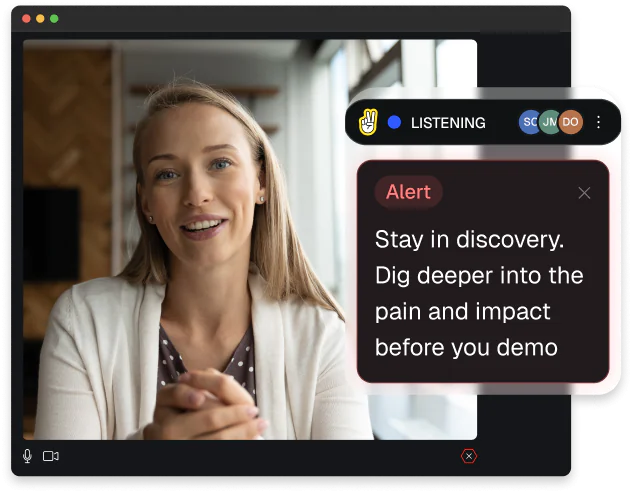
Your GTM strategy looks sharp in the board deck. Territories mapped, quota set. Then the quarter plays out on live calls nobody reviews, and the plan and the results drift apart. That gap is a GTM execution problem, and it is where enterprise revenue leaks.
This guide is for sales leaders, RevOps, and the GTM teams who own the number. It covers what GTM execution is, the pillars that hold it together, how AI changes execution on every call, and how to measure and scale it across a large team, so you can turn a strategy on paper into revenue in the pipeline.
Key takeaways
- GTM execution is the daily work of turning a go-to-market strategy into closed revenue on live sales calls.
- GTM strategy decides what a team should do, while GTM execution decides whether reps run that strategy consistently on real calls.
- GTM execution rests on three pillars: real-time guidance, playbook adherence, and pipeline visibility powered by CRM data, execution insights, and customer conversations.
- Sales reps spend most of their time on admin rather than selling, which weakens GTM execution quality.
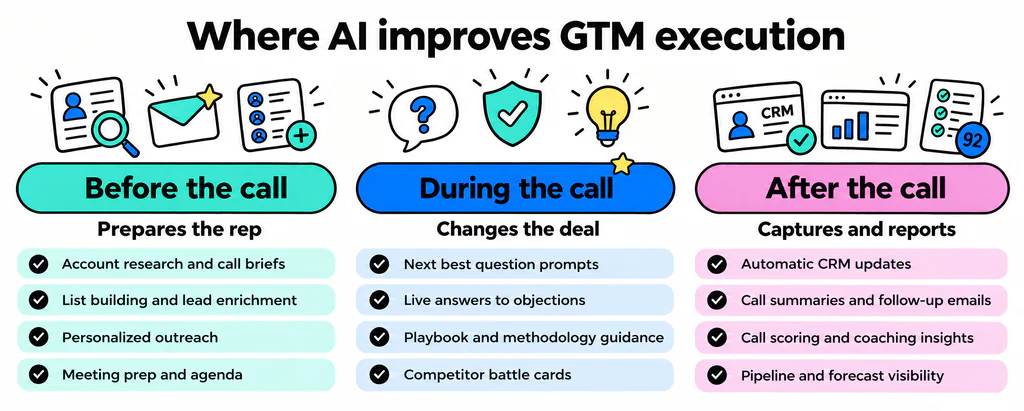
- AI supports GTM execution during the live call by surfacing guidance, answering questions, reinforcing the playbook, and capturing structured data automatically.
- RevOps strengthens GTM execution by tracking, reinforcing, and continuously improving execution across every customer conversation.
What Is GTM Execution and Why Most Teams Get It Wrong
GTM execution is the daily work of turning a go-to-market strategy into closed revenue across sales, RevOps, and the wider revenue team. It is how reps apply the playbook in real customer conversations, from discovery and qualification to handling objections, advancing deals, and driving the right next steps.
So what is GTM execution in plain terms? Strategy decides what should happen. Execution is what happens when a rep is across the table from a buyer. That is the real meaning of GTM execution: what happens in customer interactions, not what appears in the strategy document.
Most teams get it wrong because they fund the plan and assume the call takes care of itself. It does not. Reps spend most of the week on admin, prep, and note-taking rather than actually selling.
The strategy rarely fails on paper. It breaks down in the conversations where execution actually happens.
The Core Pillars of GTM Execution: Real-Time Guidance, Playbook Adherence, and Pipeline Visibility
Strong GTM execution rests on three pillars. Miss one and the whole motion wobbles.
- Real-time guidance: the next best question, the right battle card, or the objection response, available during the call instead of buried in a wiki nobody opens.
- Playbook adherence: MEDDICC, SPICED, or your own framework showing up in live discovery, so a “stage 3” deal means the same thing for every rep and every forecast.
- Pipeline visibility: real-time insight into deal health, execution, and customer conversations, from CRM data and deal risks to knowledge gaps, competitor mentions, and other signals that help leaders forecast and coach with confidence.
All three compete with selling time. Every minute spent on administrative work or searching for the right answer is a minute not spent moving the deal forward. Bad CRM data routinely causes sellers costly, embarrassing mistakes.
Reps are not careless here. They run out of time, and the CRM field is the first thing to get dropped.
How AI Is Transforming GTM Execution on Every Call
For years, the tools sold to fix GTM execution worked after the fact: dashboards, call recordings, and post-call scorecards that explain what went wrong once the buyer is already gone.
AI changes the timing. The top AI solutions for GTM execution now work inside the call, prompting the next question, surfacing answers to objections, reinforcing the playbook, and capturing structured data automatically. Vendors pitch this as B2B AI agents for dynamic GTM execution, but the test is simple: does the tool change behavior live, or only report on it after the deal has already moved on?
GTM Execution for Sales Leaders: Driving Consistency Across the Floor
For a sales leader, GTM execution is a consistency problem. Your best rep runs the motion on instinct. The other 40 need it built into their day.
You cannot join every call, so methodology drift stays invisible until the forecast misses. The fix is reinforcement in the moment: the same playbook prompted on every call, so consistency stops depending on who happens to be listening. A coaching session after the deal is already lost comes too late.
That is also where forecast confidence comes from. When reps run the same qualification live and log the same fields, your pipeline reflects what is real. For sales leader workflows, that visibility is the difference between managing the number and guessing at it.
GTM Execution for RevOps: Building the Systems Behind the Strategy
RevOps owns the systems that make GTM execution repeatable: process design, CRM architecture, and the data the whole motion runs on. When those break, the strategy breaks with them.
The recurring problem is inconsistent execution. When reps don’t follow the sales process, execution breaks down across calls and deals, making it difficult to trust forecasts, coach effectively, or improve performance at scale. For RevOps, the priority is not just better data but a system to track, analyze, reinforce, and continuously improve execution across the team.
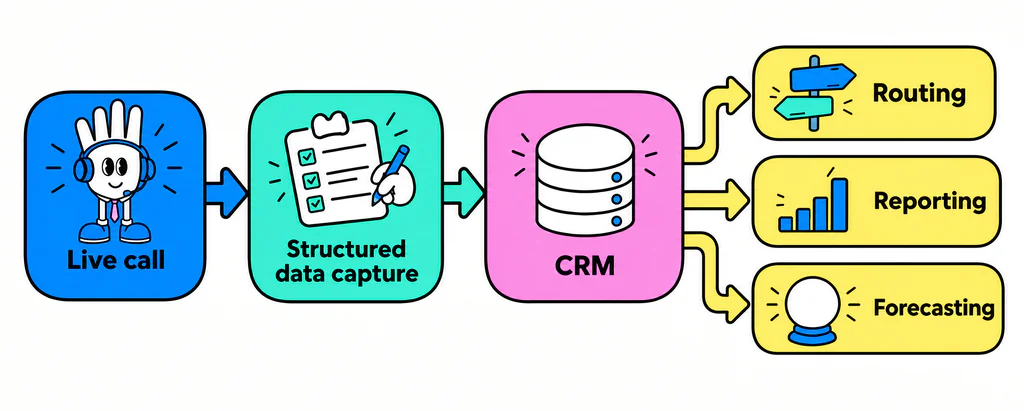
Some enterprises buy GTM execution services to layer process on top of the gap. The more durable fix is capturing structured data at the source, during the call, so RevOps CRM hygiene holds without anyone typing through discovery. Clean input is what makes routing, reporting, and forecasting trustworthy downstream.
How WINN.AI Powers GTM Execution at Scale
WINN.AI is a revenue execution platform that guides reps in real time. It joins the live meeting, walks reps through the playbook, surfaces answers to questions and objections, and provides guidance throughout the conversation. That immediate guidance is what sets WINN apart. A recording reviewed after the call can identify what went wrong, but it cannot help reps recover while the opportunity is still live.
That real-time approach strengthens each pillar of GTM execution:
- Real-time guidance keeps your playbook, methodology, and company knowledge available throughout the conversation, surfacing the right discovery questions, answers to objections, competitor guidance, and relevant information when reps need it most.
- Personalized guidance adapts to each rep and each deal. WINN analyzes the context leading up to the conversation, learns what successful execution looks like for your team, identifies recurring execution gaps, and provides guidance tailored to each rep’s needs.
- Administrative work is automated in the background, including CRM updates, meeting summaries, follow-up emails, and other post-call tasks, so reps stay focused on the customer instead of manual work.
Customer results illustrate the impact. Deel increased win rates by 33% and achieved 31% higher MEDDICC adoption by reinforcing the methodology in real time with WINN.AI. Kaseya aligned more than 1,200 reps, reduced CRM update time to 46 seconds, and cut admin time by 98%.
The platform closes the loop by giving RevOps and sales leaders visibility into execution, from skipped playbook steps and knowledge gaps to the messaging that works best. Those insights help teams refine their playbook, adjust live guidance, and continuously improve execution across the organization. Your own results will depend on your CRM setup, playbook quality, and team adoption, but the pattern holds for GTM teams running the same motion across regions.
To see how this plays out on your own calls, request a demo on a live sales conversation.
Frequently asked questions
Related

What is Sales Execution? A Practical Guide for Sales Teams
Key takeaways What Is Sales Execution and Why It Matters for Revenue Teams Sales execution is the day-to-day work of turning a sales strategy into closed revenue. It is how reps apply the playbook in real customer conversations, from discovery and qualification to handling objections, advancing deals, and driving the right next steps. Planning decides […]

How to Reduce Sales Rep Ramp Time with the Right Tools
Key takeaways Why New Rep Ramp Time Is Taking Too Long Reps usually ramp slowly because onboarding has to hold up during live buyer conversations. A plan can look clear in training and still break down when a new rep handles discovery, objections, and next steps in a live conversation. Once reps start selling, improvement […]