

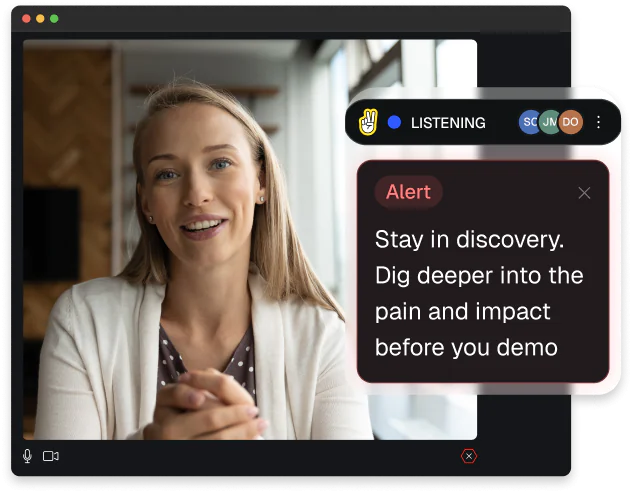
You hired a rep to add capacity, but revenue results may still be months away. The challenge is knowing whether that rep is actually progressing in the meantime: building a qualified pipeline, improving on calls, and becoming more independent. Sales ramp-up time is the path from those early signs of progress to consistent productivity. This guide is for sales leaders, RevOps, and enablement: what sales rep ramp-up time means, what slows it down, how to measure progress before the revenue results arrive, and how to shorten the path to full productivity.
- Sales ramp-up time measures how long a new sales rep takes to reach consistent quota performance.
- Sales-cycle length, deal complexity, onboarding quality, coaching access, and admin load affect ramp speed.
- Sales leaders measure ramp progress through discovery quality, qualification execution, next-step quality, pipeline development, and quota attainment.
- A 30-60-90 ramp plan works when each milestone ties to observable sales behaviors.
- A rep is fully ramped when consistent results and call execution both meet the team’s standard.
- Real-time sales guidance reduces ramp friction by reinforcing the playbook and supporting new reps during live customer conversations.
What Is Sales Ramp-Up Time?
Sales ramp-up time is the period a new rep needs to go from their first day to consistent quota performance. It is the lag between hiring and full productivity, and it is where new-hire investment starts to pay back or keeps costing the team.
Define the productivity target first, then measure the time from the rep’s start date until they consistently meet it. For a quota-carrying rep, that target might be consistent quota attainment. For example, if a rep starts on January 1 and first reaches the team’s defined target consistently in April, their ramp-up time is four months.
Leading indicators such as call execution, qualification quality, and pipeline development can show that a rep is progressing before then, but they do not by themselves mean the rep is fully ramped.
Average/benchmark ramp time by role and deal complexity
There is no single average sales rep ramp-up time. Ramp varies with deal complexity, segment, and sales cycle length, so the most useful benchmark comes from comparable hires on your own team. Look at reps in the same role and segment, measure how long it took them to consistently reach your defined productivity target, and use that range as the baseline for new hires.
What Affects How Fast a Rep Ramps
Ramp speed is mostly about the system around the rep, not raw talent. Five factors carry most of the weight.
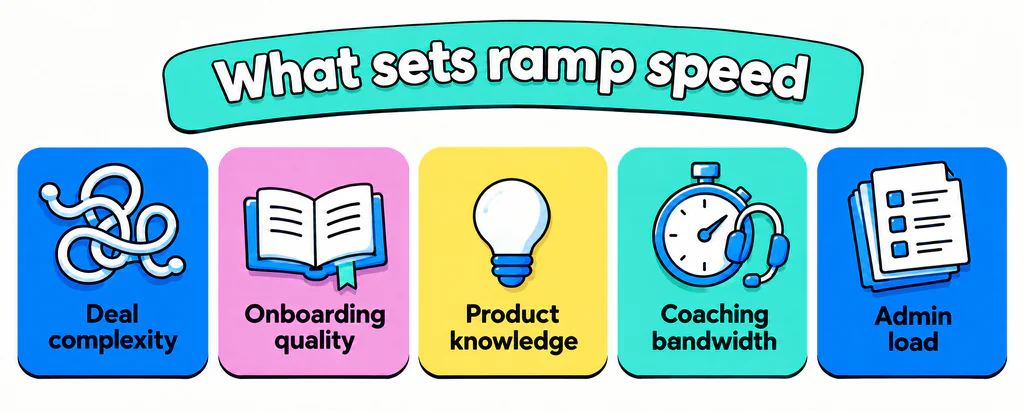
Deal complexity and sales cycle length
A longer cycle means fewer rep at-bats per quarter, so each lesson takes longer to land. Complex, multi-stakeholder deals stretch ramp because the rep has to learn qualification alongside product talk tracks.
Onboarding and enablement quality
Onboarding that ends in week one is a top reason ramp drags for months. Structured enablement that runs past the first week, with real practice, ramps reps faster than a firehose of day-one slides, and it covers the stretch where new reps stall most: learning the product and the motion at the same time.
Product/market knowledge and confidence on calls
New reps will inevitably encounter product questions they cannot answer immediately. What matters is having reliable company knowledge available when an answer exists and knowing when a question needs to be checked before responding. That helps reps stay confident without guessing or giving the buyer inaccurate information.
Manager coaching bandwidth
Managers cannot sit in every call, so methodology drift goes unseen until the deal is already off track. Limited coaching bandwidth lets bad habits set in weeks before anyone notices them in the numbers.
Tooling and admin load
Selling takes up only a small part of a rep’s week; admin, notes, and prep take the rest. Pile that load on a new hire, and the ramp stretches because hours that should build skill go to data entry instead.
How to Build a Sales Ramp-Up Plan That Works
A ramp plan turns “figure it out” into a sequence. The goal is to move a rep from knowledge to independent execution on purpose, not by accident.
Set ramp milestones (30-60-90)
Tie each window to behaviors a manager can verify, not vibes. Clear milestones tell you when a rep is on track and when to step in early. The example below uses a 30-60-90 structure, but the expected outcomes should match your sales cycle. For a longer enterprise cycle, Day 90 may mean increasingly independent execution and a healthy qualified pipeline rather than closed deals.
| Window | Milestone | What “on track” looks like |
| Day 30 | Foundations | Runs a guided discovery call, follows the playbook, and knows when to seek help on product or buyer questions |
| Day 60 | Guided execution | Runs live calls with support, identifies unanswered qualification questions, and agrees relevant next steps with buyers |
| Day 90 | Increasing independence | Runs the methodology with less support, progresses qualified opportunities, and consistently identifies and addresses gaps in the deal |

Sequence knowledge, practice, guided live calls, and independence
Order matters. Reps learn the material, practice it in role-play, then run real calls with guidance before flying solo. Skipping the guided-call step is why “trained” reps still fumble live discovery.
Put the playbook where the rep works (the live call)
A playbook in a PDF nobody opens does not change behavior. Put the playbook in the call itself with a real-time sales assistant, so a week-one rep can follow the same discovery path as an experienced rep. The sales methodology toolkit helps make MEDDICC or SPICED stick across the team, so you can keep execution consistent as you scale.

How to Measure Ramp-Up Progress and Know When a Rep Is Ready
You cannot improve ramp; you only measure at quarter-end. Track behavior weekly, because the bookings number arrives too late to fix.
Leading indicators (discovery quality, qualification execution, next-step quality)
Leading indicators show ramp progress before quota does. Watch discovery quality, qualification execution, and how effectively reps turn conversations into meaningful next steps. Look at the conversation behind the data: did the rep verify qualification criteria with the buyer, follow up on vague answers, and use what they learned to decide what should happen next? Improvement in those behaviors shows progress before the first close lands.
Lagging indicators (first deal, % to quota, consistent attainment)
Lagging indicators confirm what the leading ones predicted: time to first deal, percentage to quota, and whether attainment holds over time.
Using call data to confirm readiness with evidence
Call data gives managers evidence of how a rep is progressing before revenue results arrive. It shows whether the rep ran the playbook, asked and followed up on qualifying questions, and agreed relevant next steps with the buyer. Combined with pipeline and revenue outcomes, those behaviors help managers judge whether the rep is becoming more independent and moving toward full productivity, giving sales leaders a clearer basis for deciding where support is still needed
Common Ramp-Up Mistakes and How to Avoid Them
Most ramp problems are self-inflicted. Four show up again and again.
Treating onboarding as a one-week event
Onboarding that ends Friday of week one hands the rep a firehose and hopes it sticks. Spread enablement across the first quarter and tie it to live reps, so learning compounds instead of evaporating.
Measuring activity instead of execution quality
Call volume alone does not show whether a rep is progressing. Read activity alongside call quality and outcomes: are they having enough conversations, running discovery well, and turning those conversations into qualified opportunities and clear next steps? Looking at all three helps managers see whether a rep needs more activity, stronger execution, or support moving deals forward.
No live coaching loop after week one
When coaching stops after onboarding, drift sets in unseen. Build a coaching loop that runs on real calls every week, so you catch a skipped qualifying question while the deal is still alive.
Tools that add admin and slow reps down
A new tool that means more typing adds friction during ramp. Favor tools that capture data automatically and protect CRM hygiene, so reps spend ramp hours selling instead of updating fields.
How WINN.AI Shortens Ramp-Up Time From Day One
Ramp ends when a new rep can run a live sales conversation without a manager rescuing every next step. WINN.AI accelerates that by guiding reps in real time, building confidence from call one, and giving managers the visibility to coach precisely where it matters.
Help new reps apply the playbook on early calls
WINN.AI guides new reps through your methodology live during customer conversations, surfacing the right discovery questions, qualification steps, and objection responses as the call unfolds. A week-one rep can follow MEDDICC or your own framework because the guidance arrives when it’s needed, not because they memorized the playbook in onboarding. In the Deel case study, reps using WINN showed higher MEDDICC adoption and win rates than non-WINN users.

Every answer, every context, available in the moment
New reps carry the heaviest cognitive load on the team. They’re learning the product, the market, the buyers, and the motion all at once. WINN.AI removes the pressure to remember everything by surfacing relevant context live during the call: product details, competitive positioning, deal history, buyer information, and methodology steps. When a buyer raises a tough technical question, mentions a competitor, or pushes back on pricing, WINN provides a suggested response drawn from your company’s knowledge base. Reps don’t need to stall or promise to follow up. That safety net changes the ramp experience. New hires hit the ground running with more confidence because they know WINN is there to back them up on every call.
Guidance personalized to every rep’s execution gaps
Not every new hire struggles in the same place. WINN.AI learns what successful execution looks like for your team, then identifies each rep’s recurring patterns and weak points, whether that’s shallow discovery, missed qualification criteria, or fumbled objection handling. The guidance adapts accordingly, reinforcing the specific behaviors each rep needs to develop rather than giving everyone the same generic prompts. That targeted reinforcement builds skill faster because every call becomes a coaching moment tailored to where that rep actually needs to improve.
Full visibility for managers, without sitting in every call
Managers don’t just get pipeline visibility. They get execution visibility. WINN.AI surfaces how each rep is running the playbook, where gaps exist in process, knowledge, or skill, and which weaknesses are individual versus team-wide. Call quality scorecards, real-time coaching alignment, and execution gap reporting give managers constant clarity on what to focus on with each rep in their next one-on-one. Instead of waiting for the forecast to miss and working backward, managers can see a struggling rep’s specific breakdown (skipped MEDDICC steps, unanswered objections, weak next steps) and coach to it while the habit is still forming.
To see how live guidance works in your sales workflow, request a demo.
Frequently asked questions
Related

Top AI Sales Coaching Software to Boost Performance in 2026
Key takeaways What Is AI Sales Coaching Software AI sales coaching software analyzes sales conversations, scores them against a rubric, and gives reps and managers feedback they can act on. Instead of a manager listening to a handful of recordings, the software reviews every call and flags coaching moments at scale. Definition and core jobs […]

The Complete Sales Rep Onboarding Checklist for Enterprise Teams
Key takeaways The Sales Rep Onboarding Checklist Start here. This sales rep onboarding checklist breaks the first 90 days into four phases, so a new hire moves from systems access to closing without guessing what matters next. Use it as a sales rep onboarding plan template and adapt the timeline to your deal cycle. Week […]

Best Sales Training Software that Builds Top Performers
Your reps finish onboarding, ace the quiz, then revert to old habits on the first live call. That gap is the whole problem. The best sales training software closes that gap by reinforcing the right behaviors during live customer conversations, not just in training modules. This guide compares the main categories of sales training platform, […]