

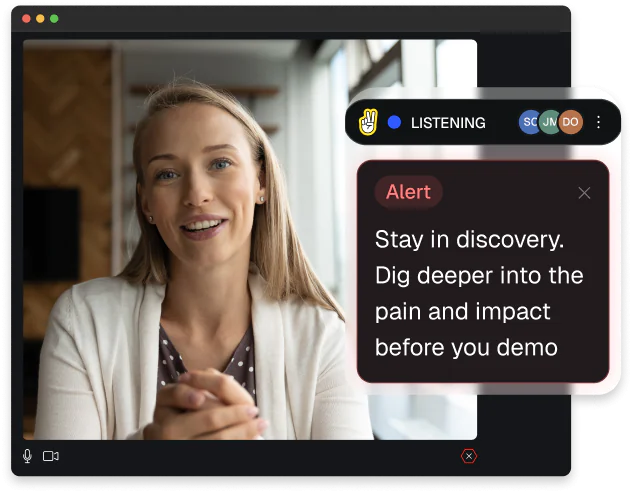
Reps chase deals that were never going to close. Leaders forecast on gut feel. The BANT sales methodology helps B2B teams qualify every lead against four criteria: Budget, Authority, Need, and Timing. This guide explains what BANT means, how to run it on a sales call, where it falls short, and how it fits modern B2B selling.
- BANT sales qualifies B2B leads by checking budget, authority, need, and timing before deeper sales work begins.
- BANT belongs in discovery because early qualification protects demos, proposals, and manager time from weak-fit opportunities.
- Budget confirms available spend, while authority identifies the people who approve, influence, or block a purchase.
- Need measures the business pain behind a deal, and timing identifies the deadline or event driving action.
- MEDDPICC fits complex enterprise deals better because it tracks metrics, champions, decision process, paper process, and competition.
- BANT only works when reps actually validate each criterion during discovery, rather than simply filling in the fields afterward.
What Is BANT in Sales?
BANT is a sales qualification framework that scores a lead on four criteria: Budget, Authority, Need, and Timing. Put plainly, BANT in sales is a fast gut-check on a prospect: can they buy, do they own the decision, do they have real pain, and will they move inside your window? It is a filter, not a full sales process.
That distinction matters more than the acronym. BANT tells you which deals deserve your hours. It does not tell you how to win them.
Where BANT came from
IBM developed BANT in the 1960s to help sellers focus their time on leads worth pursuing. It stuck around because it is simple. Four letters, four questions, one quick read on whether a deal is real. For high-velocity and transactional B2B sales, that speed still beats a heavier framework.
BANT vs a full sales methodology
Teams often treat BANT as more than it is. BANT helps teams decide which deals are worth pursuing. It doesn’t cover the deeper work of running discovery, building a champion, or mapping a buying committee. Think of BANT as the person at the door deciding who gets in. You still need a plan for the rest of the deal.
What Does BANT Stand For
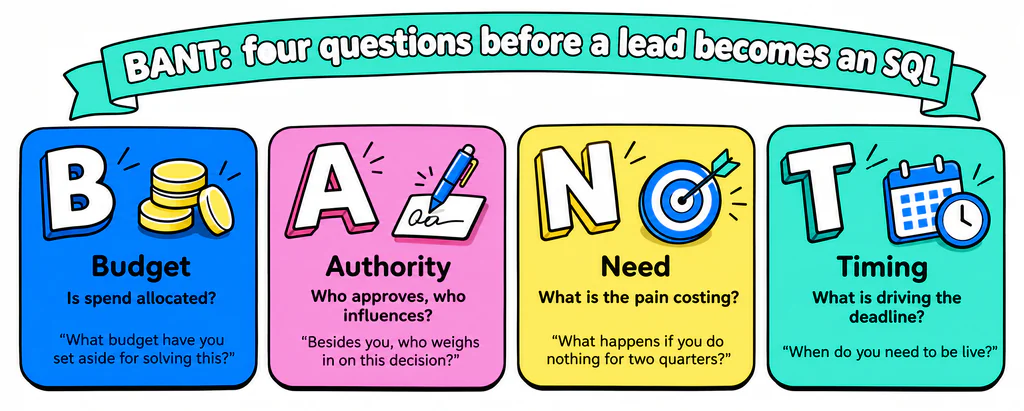
BANT stands for Budget, Authority, Need, and Timing. Each letter is a question you need answered before a lead becomes a sales qualified lead (SQL). Below are the BANT sales questions that surface each one without turning discovery into an interrogation.
Budget: can they afford it, and is spend allocated
Budget asks two things: can the prospect afford the solution, and is the money set aside? A warm “we’d love this” with no allocated spend is not a qualified deal. Ask: “What budget have you set aside for solving this?” and “Who approves spend at this level?”
Authority: who signs, and why single-threading fails
Authority identifies who can approve the purchase and who else can influence the outcome. Single-threading on one friendly contact is the fastest way to lose a deal in a buying committee. Ask: “Besides you, who weighs in on this decision?” and “How have similar purchases been approved before?”
Need: the business pain BANT must surface
Need is the business pain driving the search. Get past the surface problem and understand what it is costing the buyer to leave it unresolved. Ask: “What happens if you do nothing for another two quarters?”
Timing: compelling event and buying window
Timing pins down the buying window and the compelling event behind it. A deal with no deadline tends to slip forever. Ask: “Is there an event or deadline driving this now?” and “When do you need to be live?”
How to Use BANT for Sales Qualification
BANT sales qualification works when it becomes a repeatable habit, not a form reps fill in after the fact. Run the framework as a lightweight loop on early calls and the rest of your pipeline gets cleaner on its own.
When in the cycle to run BANT
Run BANT during discovery, on the first or second call. The goal is to qualify or disqualify before you invest in demos, proposals, and committee meetings. Used this early, the bant sales qualification framework protects your calendar and your forecast.
BANT qualifying questions that don’t sound like an interrogation
Weave the four questions into a normal conversation instead of reading them off a list. Anchor each one to the prospect’s own words. If they mention a Q3 launch, that is your opening for Timing. If they name a VP, that is your opening for Authority. Curiosity qualifies better than a checklist.
Scoring and acting on BANT
Turn the bant sales process into a clear next step:
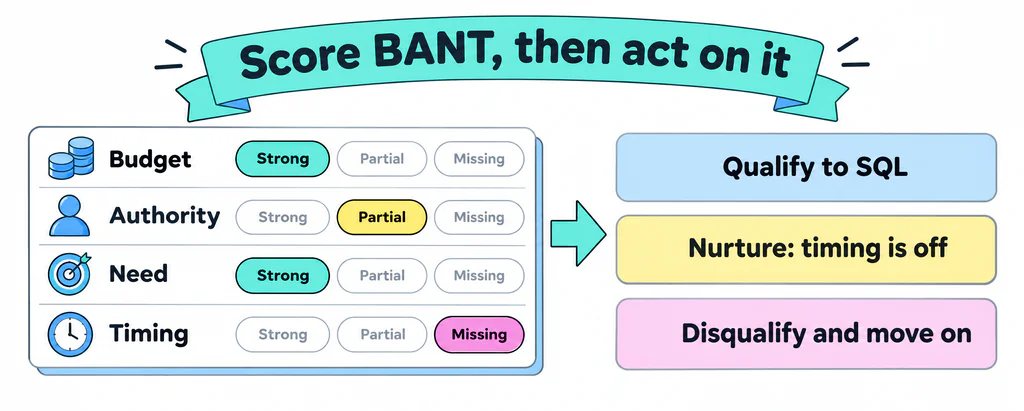
- Score each criterion as strong, partial, or missing during the call.
- Log the answers in your CRM against the opportunity, not in a notebook.
- Act on the read: qualify to an SQL, nurture if timing is off, or disqualify and move on.
A deal with strong Budget and Need but unknown Authority is not dead. It is a signal to multi-thread before you forecast it. Capturing those criteria cleanly is also a CRM hygiene problem, because a score that never reaches the CRM cannot help anyone else on the team.
BANT vs MEDDPICC: Which Framework Fits Your Sales Motion
BANT and MEDDPICC solve different problems. BANT qualifies a lead fast. MEDDPICC manages a complex deal over its full cycle. Neither is “better”; the right fit depends on your sales motion. The same comparison logic applies to MEDDIC, CHAMP, and SPICED.
What MEDDPICC adds that BANT misses
MEDDPICC goes deeper than BANT on the things that decide enterprise deals: quantified Metrics, the Economic buyer, Decision criteria, the Decision process, the Paper process, the Identified pain, your Champion, and the Competition. BANT touches budget and authority at a glance. MEDDPICC works them as living parts of the deal.
Choosing by deal complexity and motion
| Dimension | BANT | MEDDPICC |
| Focus | Fast lead qualification | Deep deal qualification and management |
| Best deal size | SMB, transactional, high velocity | Mid-market to enterprise, complex |
| Depth | 4 criteria | 8 criteria, tracked through the cycle |
| Speed to apply | Minutes, on a first call | Ongoing, across the deal |
| Biggest blind spot | Single-threaded Authority | Heavier to learn and maintain |
For SMB and velocity motions, lead with BANT. For enterprise, start with BANT to filter, then run MEDDPICC on the deals that pass. The choice should follow your sales motion, not the acronym that sounds more sophisticated.
Where BANT Falls Short in Modern B2B Sales
BANT was built for a simpler buying process. Modern B2B sales added more stakeholders, longer cycles, and higher proof standards, and that exposes four real gaps.
BANT breaks down when reps don’t execute it in the moment
The biggest gap is execution. Under pressure, reps don’t always run BANT consistently: budget feels awkward, so it gets skipped; the conversation is going well, so nobody asks who else is involved; or the rep jumps to the demo before validating the need. Even a well-designed qualification framework only works if reps actually apply it during the conversation.
Buying committees break the “Authority” assumption
BANT’s Authority criterion can oversimplify who holds decision-making power. Gartner reports that B2B buying groups can include five to 16 people across as many as four functions. When you qualify on one person’s “yes,” you can miss blockers, finance approval, and other stakeholders who influence the decision.
“Need” alone misses quantified business impact
BANT confirms that pain exists. It does not quantify it. A deal qualified on “yes, we have this problem” still stalls when no one has put a number on the cost of inaction. That number is what survives a budget review.
Criteria captured once, then never updated
This is the quiet killer. Budget shifts, champions leave, timelines slip. BANT criteria captured on the first call and never refreshed turn into stale pipeline data that misleads the forecast. The problem isn’t always BANT itself, but how it’s applied. Reps need to validate each criterion during the conversation and revisit it as the deal evolves.
How WINN.AI Helps Reps Apply BANT on Every Call
Most teams don’t struggle to understand BANT. They struggle to apply it consistently on real calls. Reps skip uncomfortable questions, move on before validating a criterion, or jump to the demo before qualification is complete.
With sales reps spending only 40% of their time selling, every BANT field re-keyed after the call takes time away from selling. WINN.AI is a revenue execution platform that guides your reps live and captures qualification answers during the conversation.
Real-time guidance helps reps apply BANT consistently
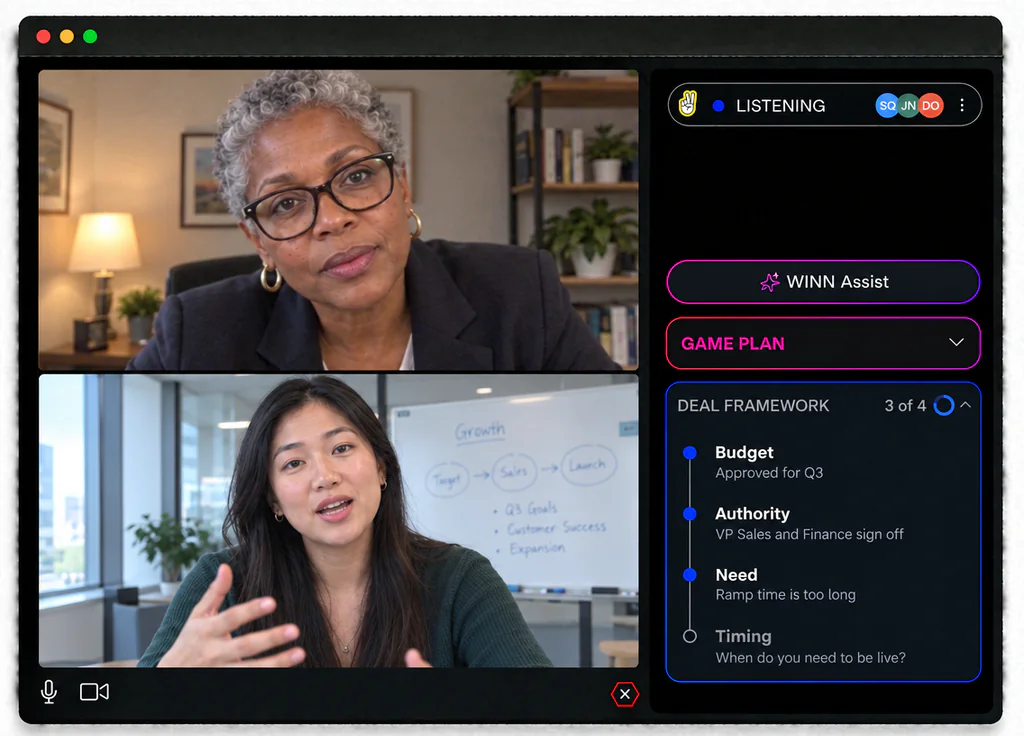
WINN.AI joins the live call and reinforces your playbook in the moment, helping reps address Budget, Authority, Need, and Timing consistently while the conversation is still unfolding. That helps reps stay aligned with the qualification framework as the conversation develops. BANT ships as one of WINN.AI‘s built-in playbook templates, along with MEDDICC, SPICED, Challenger, Gap Selling, and Solution Selling.
Auto-captured criteria written straight to the CRM
The answers do not live in a notebook. WINN.AI turns the conversation into structured fields and writes them to Salesforce or HubSpot automatically, while reporting a 9× higher CRM fill rate. As a real-time sales assistant, it captures qualification data while the call is still happening, helping reps apply their qualification framework consistently and keeping CRM records up to date.
Consistent qualification gives leaders a clearer view of the pipeline
When reps apply BANT consistently and the resulting qualification data reaches the CRM, leaders get a clearer view of which deals are actually qualified and where important criteria are still missing. That makes it easier to spot gaps before they turn into forecast surprises. See how it fits your team and book a demo.
Related

Sales Workflows: How RevOps Teams Automate From Call to Follow-Through
What Are Sales Workflows? A sales workflow is a repeatable sequence of triggers and actions that moves a deal forward. Lead comes in, lead gets routed. Call ends, CRM gets updated. Each one is small. Together they run your revenue motion. Sales workflow vs. sales process vs. sales automation People use these three terms like […]

The 2026 GTM Execution Guide for Enterprise Revenue Teams
Key takeaways What Is GTM Execution and Why Most Teams Get It Wrong GTM execution is the daily work of turning a go-to-market strategy into closed revenue across sales, RevOps, and the wider revenue team. It is how reps apply the playbook in real customer conversations, from discovery and qualification to handling objections, advancing deals, […]

Top AI Sales Coaching Software to Boost Performance in 2026
Key takeaways What Is AI Sales Coaching Software AI sales coaching software analyzes sales conversations, scores them against a rubric, and gives reps and managers feedback they can act on. Instead of a manager listening to a handful of recordings, the software reviews every call and flags coaching moments at scale. Definition and core jobs […]